
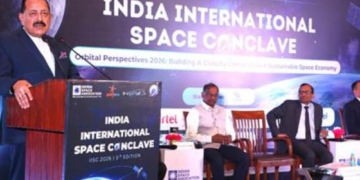
NEW DELHI, Nov 24 : India’s space economy, currently valued at nearly USD 9 billion, is set to grow to USD 40-45 billion in less than a decade, with the private sector driving a major transformation of the country’s space ecosystem, Union Minister of State (Independent Charge) for Science & Technology and Earth Sciences, and Minister of State in the Prime Minister’s Office, Personnel, Public Grievances and Pensions, Atomic Energy and Space, Dr. Jitendra Singh said today.
Addressing the fifth India International Space Conclave 2026 in New Delhi, the Minister said India’s space ecosystem has expanded from single-digit startups to nearly 400-500 companies in just a few years, demonstrating how the reforms initiated under Prime Minister Narendra Modi have unlocked the country’s immense entrepreneurial and technological potential.
The two-day conclave, organised by the Indian Space Association (ISpA) on November 23–24, 2026, at New Delhi, was centred on the theme ‘Shaping the Future of Space through Innovation, Governance, Human Potential and Global Collaborations’. It brought together industry leaders, space startups, researchers and international stakeholders to deliberate on India’s growing role in the global space economy. The occasion also witnessed the launch of the report ‘Space Economy 2036: The India Blueprint’.
The programme was attended by Dr. V. Narayanan, Chairman, Indian Space Research Organisation (ISRO) and Secretary, Department of Space (DoS); Dr. Pawan Kumar Goenka, Chairman, IN-SPACe; Lt Gen Anil Kumar Bhatt (Retd), Director General, Indian Space Association; and Arun T. Ramchandanialong with other prominent representatives of the space industry and technology ecosystem.
Dr. Jitendra Singh said the establishment of NewSpace India Limited (NSIL), followed by the creation of IN-SPACe and the opening up of the space sector to private participation, marked a decisive transformation in India’s space journey. Describing these reforms as among the most transformative policy decisions in recent decades, he said they broke the traditional status quo and enabled private enterprises to participate in a sector that had largely remained within the government domain.
Citing the progress of Indian space startups, the Minister referred to Skyroot’s maiden launch vehicle flight on July 18, 2026, its multi-mission launch agreement and unicorn status as significant milestones. He also cited Agnikul and other companies developing advanced propulsion systems, privately built rocket engines, earth-observation technologies and satellite imaging capabilities as evidence of India’s growing technological strengths. He said the expanding participation of companies from other industrial sectors further demonstrated the commercial opportunities emerging from the reforms.
The Minister said the economic contribution of space technology must be measured not only through rocket launches, satellite manufacturing and commercial revenues but also through the savings, efficiencies and improved outcomes it generates across sectors on the ground.
Citing the PM Gati Shakti National Master Plan, he said space-based applications help improve infrastructure planning, maintain project timelines, reduce costs and minimise wastage and leakages. He said space technology has applications across virtually every Ministry, including infrastructure, construction, communication, education, healthcare, railways and defence.
During the interactive Q&A session, responding to a question on generating greater demand for the space industry, Dr. Jitendra Singh said the perceived lack of demand was largely linked to insufficient awareness about the practical applications of space technology. He said its potential extended far beyond rocket launches and satellite missions, with significant opportunities in infrastructure, communication and public service delivery. He also cited the Prime Minister’s whole-of-government approach and inter-ministerial collaboration as important enablers for expanding the use of space technology across sectors.
Responding to a question on balancing strategic sovereignty with international cooperation, Dr. Jitendra Singh said technological sovereignty and global collaboration were not contradictory. He said India must continue to strengthen indigenous capabilities, with the guiding approach centred on indigenous sources, indigenous technology and indigenous projects, while remaining open to mutually beneficial international partnerships.
The Minister also referred to India’s progress under the National Quantum Mission, launched by Prime Minister Narendra Modi in 2023 with an eight-year mandate. He said India had achieved 1,000 kilometres in secure quantum communication in just three years, against the original target of 2,000 kilometres over eight years. He said space, quantum technologies, semiconductors and nuclear science were interconnected areas offering significant opportunities for technological advancement and commercial growth.
Dr. Jitendra Singh urged domestic private players to scale up investments in the space sector and encouraged industry leaders to facilitate greater overseas investment into India’s growing space ecosystem. He said the government had introduced enabling mechanisms, including the Anusandhan National Research Foundation and the Research, Development and Innovation (RDI) Fund, to strengthen research and innovation and encourage private-sector participation.
The Minister also urged industry leaders to direct greater Corporate Social Responsibility (CSR) support towards research and scientific development. He said CSR should serve the wider community and not remain confined to expenditure on machinery and infrastructure. Calling for a stronger culture of scientific philanthropy, he said investment in research should be regarded as a meaningful contribution to society and humanity.
During the session, he also responded to suggestions on an international space innovation alliance, a global accelerator programme for startups and international grand challenges to encourage innovation. He said India must adopt global strategies and benchmarks to strengthen its international role and that possibilities for institutionalising wider international space cooperation could be explored.
Welcoming suggestions from industry representatives on expanding the space ecosystem to more states and encouraging greater participation of students and young innovators, Dr. Jitendra Singh said the government remained open to constructive feedback and further policy improvements to facilitate private-sector participation.
The Minister said India’s space transformation, driven by policy reforms, indigenous technological capabilities and private-sector entrepreneurship, was creating a strong foundation for the country’s emergence as a globally competitive space economy.